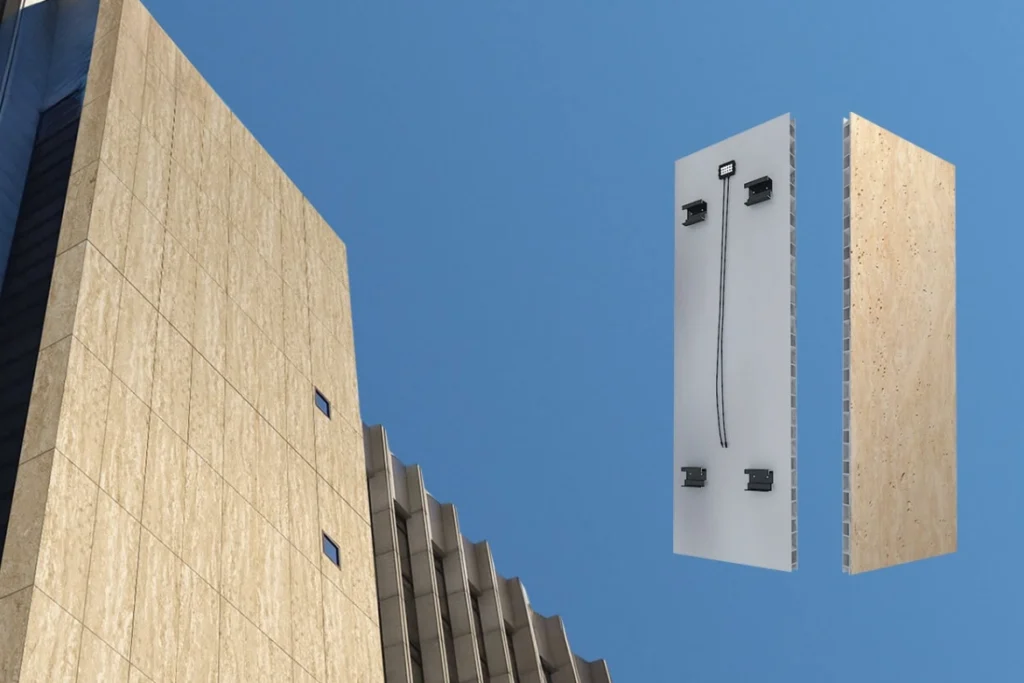
Building facades are usually designed to protect the structure and create a particular architectural appearance. eSolarFacades by Phomi takes a different approach by integrating photovoltaic technology directly into the building envelope.
The system is designed to combine the appearance of materials such as stone, wood, or brick with renewable energy generation. Instead of adding conventional solar panels as a separate feature, photovoltaic technology becomes part of the facade itself.
Solar Technology With an Architectural Finish
eSolarFacades are designed for projects where the appearance of the building is important alongside energy generation. The facade can be customized with different colors and textures, allowing designers to create surfaces that resemble stone, wood, brick, and other architectural finishes.
Standard module dimensions include 1140 × 570 mm, while custom dimensions are also available. The modules have a thickness of 30 mm, with additional available sizes including 1200 × 600 mm, 1254 × 751 mm, and 1260 × 746 mm.
Photovoltaic Performance
Under Standard Test Conditions, or STC, using 1000 W/m² irradiance, AM 1.5, and a temperature of 25°C, the modules are specified with maximum power outputs ranging from approximately 59.23 W to 166.62 W, depending on the configuration.
The maximum power voltage ranges from approximately 20.70 V to 29.22 V.
Phomi states that its eSolarFacades can achieve 60% higher power efficiency than glass BIPV with 60% transmittance. The company also states that carbon emissions are 54.6% lower than glass BIPV under its stated comparison.
Designed for Building-Integrated Solar
Building-integrated photovoltaics, or BIPV, incorporates solar technology into architectural elements instead of treating solar panels as an addition to the building.
eSolarFacades follow this concept by combining the facade surface and photovoltaic function into one architectural system. This approach can be particularly useful for buildings where conventional rooftop solar has limited available space or where designers want renewable energy technology to form part of the exterior appearance.
Strong and Weather Resistant
The modules use an aluminum honeycomb composite panel with an aluminum frame as the back support structure. They are specified with a maximum front and rear surface load of 2400 Pa for wind and snow conditions.
For hail resistance, the system is tested against 25 mm diameter hail at 23.0 m/s. The junction box is IP68 rated and TUV certified. Unlike conventional glass-based photovoltaic modules, the eSolarFacades specifications provided by Phomi list no glass as the facade surface material.
Lightweight Facade Construction
The module weight is approximately 15.28 kg/m², although the final weight can vary depending on the selected texture. This allows the photovoltaic facade to be designed with different architectural finishes while maintaining a relatively consistent module-based construction system.
The combination of the aluminum frame and honeycomb composite structure provides the supporting framework for the facade system.
Energy Storage Options
Phomi also offers off-grid energy storage systems based on the purchase configuration. These systems can include batteries, controllers, and inverters, allowing the photovoltaic facade to be combined with energy storage and power-management equipment.
This can make the system suitable for projects that need more than direct solar generation, particularly where stored energy is required for later use.
A Facade That Does More Than Protect a Building
eSolarFacades show how photovoltaic technology can become part of a building’s architecture rather than remaining a separate rooftop installation. By combining customizable architectural textures with solar generation, the system is designed to turn exterior building surfaces into functional energy-producing elements.
With multiple module sizes, customizable colors, photovoltaic outputs up to 166.62 W per module under the stated conditions, and optional energy-storage components, eSolarFacades offer another approach to integrating renewable energy into modern building design.
Source: Phomi

